Tuesday, 21 June 2016

Islamic State launches counter-attacks on U.S.-backed forces, Syrian army

The Islamic State group launched a counter-attack against fighters trying to capture the Syrian city of Manbij on Monday, inflicting heavy casualties on the U.S.-backed forces, the Syrian Observatory for Human Rights and the militants said.
The monitor said the militants won back three villages south of the besieged city in a surprise assault against fighters from the U.S.-backed Syria Democratic Forces. At least 28 SDF fighters were killed.
Two years after IS proclaimed its caliphate to rule over all Muslims from swathes of territory in Iraq and Syria, its many foes are advancing on a number of fronts in both countries. Their aim is to close in on its two capitals, Raqqa in Syria and Mosul in Iraq.
The SDF were poised to enter Manbij nearly three weeks after the launch of a major assault to regain the city backed by U.S. air power and American Special Forces, to seal off the last stretch of the Syrian-Turkish frontier
The alliance, formed last year by recruiting Arabs to join forces with a powerful Kurdish militia, fought to nearly 2 km (1.24 miles) from the city center from the western side on Saturday before retreating.
U.S-led coalition jets hit militants taking cover near a large wheat silo complex on the southern edge of the city that has been encircled by SDF forces.
An SDF spokesman said forces succeeded in repulsing the militant attack and remained positioned on the outskirts of the city, most of whose residents remain trapped inside due to mines planted by the militants, who have dug in to defend it.
"The situation is under control. They have many bodies on the ground," Sharfan Darwish, spokesman for the Syria Democratic Forces-allied Manbij Military Council, told Reuters.
"We are at the four gates to the city. The whole city is booby-trapped. After 20 days of the campaign, we have yet to storm the city," he added, adding that some 2,000 people had succeeded in fleeing the city.
Islamic State militants were also able to roll back the Syrian army, which had reached as close as 10 km (6.2 miles) south of the strategic town of Tabqa, an Islamic State-held city on the Euphrates River, in Raqqa province.
The town, some 50 km (30 miles) west of Raqqa city, the militant's defacto capital, appears to be the first target of a major Syrian army assault in Raqqa province backed by Russian air power that began earlier this month. [L8N18W058].
Tabqa dam and a major air base have been in militant hands since 2014.
The monitor said the army reverses on Sunday lost it territorial gains made in over two weeks of advances in Raqqa province which enabled it to cross its provincial boundary for the first time in over two years.
Amaq news agency, which is affiliated with the militants, said suicide bombers had attacked Thawra oil field, south of Tabqa, which the Syrian army had captured earlier this week, and regained it.
Eyad al Hosain, a Syrian journalist embedded with Syrian troops, told Reuters the militants had succeeded in regaining areas they lost near the oil field. He did not give figures on army casualties.
"A very intense attack has targeted army and allied positions in Thwara field that led to the withdrawal of troops from areas they liberated... and their retreat," al Hosain said.
Amaq also said militants seized a Syrian army checkpoint near a strategic junction which leads to Raqqa city that the Syrian government forces and their allies had seized in the early phase of its Raqqa campaign.
The monitor, which tracks violence across the country, said the militants had sent reinforcements and cited at least 300 fighters heading to Tabqa from Raqqa.

State media also reported clashes with the militants around the main Jazal field near the ancient city of Palmyra in the country's central desert. The army and its allies continue to fight a costly war of attrition against Islamic State militants several months after seizing the city from them.
Khaldi, Suleiman Al. "Islamic State Launches Counter-attacks on U.S.-backed Forces, Syrian Army." Reuters. Thomson Reuters, 20 June 2016. Web. 21 June 2016.
Response
Islamic State once again involved themselves in another fight. They launched a surprise attack on US-backed forces, Syrian army. IS claimed to control over Syria and Iraq by capturing their capital cities. As known to most of the people, IS became one of the most well-known and powerful terrorist groups. This article points out that attempts are being made to stop IS from going completely crazy. It obviously has a strong bias against IS and the author seems to defend and almost glorify the Syrian army. My concern about this is that are enough attempts made to stop IS. IS obviously is the most threatening terrorist organization and the governments should "continue to fight a costly war of attrition against IS"

Tuesday, 14 June 2016

Orlando Shooter Omar Mateen 'was a Regular at Pulse Nightclub

The gunman who killed 49 people in an attack on a gay nightclub in Orlando is said to have been a regular at the venue and had messaged several people on gay dating apps.
Four regular customers said they had seen killer Omar Mateen drinking at the nightclub on multiple occasions. “Sometimes he would go over in the corner and sit and drink by himself, and other times he would get so drunk he was loud and belligerent,” Ty Smith told the Orlando Sentinel


“We didn’t really talk to him a lot, but I remember him saying things about his dad at times,” Smith said. “He told us he had a wife and child.”
The news that Mateen may have been a regular at Pulse added another dimension to the profile of a man who had in the past been on an FBI watchlist. His former wife said he was mentally unstable and violent.
One Pulse regular, Chris Callen, who performs under the name Kristina McLaughlin and is married to Smith, said he had witnessed violent outbursts by Mateen at the club.
As accounts of the shooter’s reported appearances at the Pulse emerged, thousands of Orlando residents packed a downtown square in memorial of the dead. Bells at the First Methodist church tolled 49 times for each of the victims, the last of whom to be identified, Akyra Monet Murray, and also the youngest at 18, was named shortly before the vigil began.
As the crowd at the vigil raised up candles in front of the Dr Phillips Art Center that had been lit in rainbow colors, faith leaders including an imam and Hispanic evangelicals joined LGBT activists and campaigners against gun violence in a collective cry of defiance that love would conquer hate.
“We remain a city in pain. We are mourning and we are angry,” said mayor Buddy Dyer, who told the crowd that Orlando had become itself the victim of a dreadful irony. “Our city, a joyful melting pot of cultures and ways of life, now has to bear the title of the site of the worst mass shooting in American history.”
Two prominent members of the Pulse community addressed the vigil. The club’s manager Neema Bahrami said to a huge cheer: “I want you to know we are not leaving. We are here to stay. We will be bigger and better than you can ever imagine. We will not be defeated. We are here to stay.”
The Pulse’s co-founder Ron Legler said that he and Barbara Poma had opened the popular gay venue “as a place of pride. A place you could feel safe. We are going to rebuild that Pulse.”

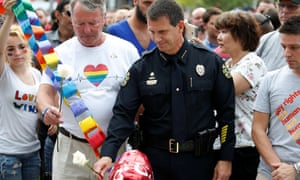
Orlando mayor Buddy Dyer and police chief John Mina at a memorial service for victims
Pinterest
 Orlando mayor Buddy Dyer and police chief John Mina at a memorial service for victims. Photograph: Carlo Allegri/Reuters

Terry DeCarlo of the GLBT Community Center in Orlando told the vigil that he had received messages of condolence and solidarity from all around the world. The mayors of Berlin and London, leaders from Australia, Spain and Brazil had all contacted him “saying Orlando we see you, we stand with you, we love with you,” he said.
Among the huge assembly at the vigil, many of whom carried rainbow flags or the national emblem of Puerto Rico in reflection of the large number of Hispanic victims, was a man who described to the Guardian his extraordinary story of survival at the Pulse. Orlando – he would not give his last name – described how for three terrible hours he lay motionless on the ground in a back bathroom of the club, his head rammed up against the toilet bowl, trying to maintain total silence.
In all that time, he said, as the shooter of the Pulse nightclub massacre calmly moved around him, he kept having just one thought.
“I’m not going to make it out of here. I kept thinking I wasn’t coming out of this, I just wasn’t.”
Orlando and two other terrified club goers at the popular gay venue avoided drawing the gunman’s attention by playing dead, as all around them they could hear the carnage. “Everyone was screaming and bellowing, except for us. Me and my friend kept quiet, we could hear the shooter talking to people in the next bathroom stall.”
The club goer said he heard Mateen ordering people in the adjacent bathroom stall not to use their phones to make text messages. “He said, ‘Please don’t text’. That was the words he used.”
He also heard the shooter make a call, apparently to the police, and making the statement that America should stop bombing Isis in Syria.
Orlando recalls hearing the gunman make reference to a bomb vest in other phone calls, as well as a strange moment in which he demanded to know if anyone in the bathroom was African American. “I have no problems with black people,” the shooter said.

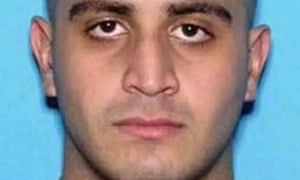
Omar Mateen
Pinterest
 Omar Mateen was a regular at the Pulse nightclub. Photograph: Rex/Shutterstock

Finally, explosions ripped through the wall of the bathroom as the police SWAT team made their controlled entry. The air filled with dust as a hole was punched in the wall, a wild burst of shooting ensued, and Orlando found himself being tugged up out of the stall by officers and hurled physically out of the hole and into the open air.
“An office just grabbed me and flung me out through the hole,” he said.
As he recounted the story, Orlando was still sporting the medical tag from Florida Hospital where he was treated.
Further accounts of the shooter’s apparent interaction with gay culture in advance of his rampage were given by users of a gay dating app Jack’d who told news outlets that Mateen had contacted them through it. Kevin West, 37, a former Navy serviceman, said he been messaged by Mateen on the app.
Though out of touch with him for a few months, West said he had received a message from Mateen saying he was in town and asking to meet for a drink.
West told the LA Times he had immediately contacted the FBI after seeing Mateen’s picture on the news, handing over his login details to his Jack’d app.
Another man apparently messaged by Mateen on the dating app was 23-year-old Cord Cedeno, who also told the Washington Post he had seen Mateen at the club before. “It was definitely him. He’d come in for years, and people knew him,” Cedeno said. “He was open with his picture on the sites; he was easy to recognise.”
His former classmate Samuel King, who also worked at the same shopping mall as Mateen after high school, said Mateen had known that he and many of his friends were gay but never expressed any disapproval. “He had to know it, but I never got any sense of homophobia or aggression from him,” he told the Washington Post.
The information adds to a complex and often contradictory picture that is emerging of the gunman and his motivation for the outrage. His father, Seddique Mateen, hours after the shooting said that Mateen had once become incensed when he saw two men kissing in Miami in front of his wife and child.

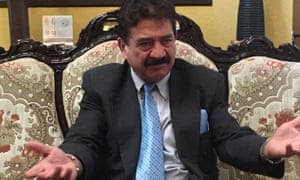
Seddique Mateen speaks with reporters at his home in Port Saint Lucie
Pinterest
 Seddique Mateen speaks with reporters at his home in Port Saint Lucie. Photograph: Reuters

However, in an interview with the Guardian, the father indicated he believed the importance of the incident had been overblown. “But that was a couple of months ago and he never talked about it afterwards,” he said. “I don’t think that incident would trigger this kind of violent reaction.”
Details have also emerged as to how Mateen was able to buy two powerful weapons with which he carried out the attack - .223 assault rifle made by Sig Sauer and a Glock 9mm handgun. He bought the firearms in three separate visits earlier this month to a gun range and store about 15 miles from his home in Fort Pierce.
The owner of the St Lucie Shooting Center, a retired New York city police officer called Ed Henson, told reporters that he had no responsibility for what had happened. Mateen had passed a full federal background check before he was allowed to buy the guns, Henson said, and besides “”If he hadn’t purchased them from us I’m sure he would’ve gotten them from another shop in the area.”
Now that all 49 of the dead have been identified, and their families told the dreadful news, Orlando will be able to begin the long process of grieving. Five of the 53 injured remain in grave condition in hospital, with 47 still in treatment.
President Obama will visit the city on Thursday for a ritual of mourning and reflection that has become all too familiar to him in his eight years in office – this being the 15th time he has had to address the dark subject of mass shootings. Then after that, the funerals will begin.
Pilkington, Ed, and Jessica Elgot. "Orlando Shooter Omar Mateen 'was a Regular at Pulse Nightclub'" The Guardian. Guardian News and Media, 14 June 2016. Web. 14 June 2016.
Response
Gender Identity problem has been the most sensitive issue these days. Orlando shooter Omar Mateen shot and killed 49 people and harmed 53 people at the gay nightclub. Media kept portraying him as a homophobic. However, this article mentions that he used gay dating app and he has shown no homophobic or aggressive actions to gay people. It is unclear why he wanted to kill the people at a gay nightclub but it doesn't clearly seem to be that his hatred of gay people was the only reason to pull the trigger to his insanity. No matter the reason, this action wasn't acceptable and we should all be in grief of those who died. 

Tuesday, 7 June 2016

Amnesty says Malawi albino killings reflect police failures

 LILONGWE, June 7 (Reuters) - Amnesty International accused Malawian police on Tuesday of failing to protect people with albinism who are targeted for their body parts which are used in magical potions and other ritual practices.
Police said they were doing all in their power to end the surge in the killing of albinos in the southern African country. Albinos have also been targeted in Malawi's neighbour Tanzania and elsewhere in Africa.
Deprose Muchena, Amnesty International's Director for Southern Africa, said in a statement that Malawian authorities had failed to protect the albinos, leaving them at the mercy of criminal gangs who hunt them down for their body parts.
The report says at least 18 people with albinism have been killed in Malawi since November of 2014 while at least five others are known to have been abducted and remain missing. Four were murdered in April 2016, including a baby.
"Their bones are believed to be sold to practitioners of traditional medicine in Malawi and Mozambique for use in charms and magical potions in the belief that they bring wealth and good luck," Amnesty said.
"The macabre trade is also fuelled by a belief that bones of people with albinism contain gold."
Malawi government spokesperson and Minister of Information Patricia Kaliati dismissed the claims by Amnesty.
"We are doing everything within the law to stop this carnage," Kaliati told Reuters.
Malawi Police spokesman Nikolasi Gondwa said gangs in neighbouring Tanzania and Mozambique were fuelling the trade.
Albinism is a congenital disorder affecting about one in 20,000 people worldwide who lack pigment in their skin, hair and eyes. It is more common in sub-Saharan Africa. (Reporting by Mabvuto Banda; Editing by Ed Stoddard and James Macharia)

"Amnesty Says Malawi Albino Killings Reflect Police Failures." Mail Online. Ed. Ed Stoddard and James Macharia. Associated Newspapers, 07 June 2016. Web. 07 June 2016.

Response

Albino killings had been a problem in the continent of Africa for a long time. It has become a problem again in Malawi and the problem has even addressed the police problem in Malawi. People are saying that Malawi police has failed to protect albinos in their country and still lots of people are being abducted and killed. This is a religion related problem where African people believe that albinos are somehow magical and they use it in charms and magical potions. It is a barbaric action and it must be stopped no matter what. It clearly violates all the rights of albinos and Malawi government shouldn't take this issue lightly. They must take a clear and definite action to punish those who practice such nonsense, barbaric action against albinos. 

Wednesday, 11 May 2016

Pandora leads European equities higher, Greek stocks outperform

May 10 U.S. Secretary of State John Kerry will meet representatives of British and European banks in London on Thursday to discuss issues involved in doing business with Iran, a British banking industry source said on Tuesday.
The United States and Europe lifted sanctions in January under a deal with Iran to limit its nuclear programme, but other U.S. sanctions remain, including a ban on transactions with Iran in dollars being processed through the U.S. financial system.
This has meant that few European banks, and none of the big ones that have deep relationships with the U.S. banking system, have been willing to get involved in trade with Iran, much to Tehran's frustration.
The British Bankers' Association confirmed a meeting was due to take place between Kerry and representatives from member banks, but declined to provide further details.
An industry source in London said Iran would be the focus of the meeting and representatives from several European banks would also be involved.
A spokesman travelling with Kerry, who is in Paris and London this week for meetings with European counterparts and an anti-corruption conference, did not immediately respond to a request for comment.
Kerry said last month that the United States was not opposed to foreign banks doing business with Iran in line with the terms of last year's nuclear deal.
He said he wanted to clear up uncertainty in the business community outside the United States about investing in Iran.
The Iranian government has complained about not getting the full economic fruits of the nuclear deal. Ayatollah Ali Khamenei, the most powerful figure in Iran, has blamed the delays squarely on the United States.
"The U.S. Treasury ... acts in such a way that big corporations, big institutions and big banks do not dare to come and deal with Iran," Khamenei said in March.
The Iranian business community's hopes of rapidly emerging from years of economic isolation have been fading.
Iranian business leaders believe the United States has failed to spell out exactly what is permitted and what is not, maintaining uncertainty and putting off international banks from processing Iran-linked transactions. (Reporting by Rachel Armstrong, Jonathan Saul and David Brunnstrom; Writing by Estelle Shirbon; Editing by Tom Heneghan)

"Kerry to Discuss Iran with European Banks in London." Reuters. Thomson Reuters, 10 May 2016. Web. 10 May 2016.

Response
The conflict between U.S. and Iran continues as U.S. sanctions remain against Iran after the U.S. and Europe lifting sanctions in January under a deal with Iran to limit its nuclear programme. Big banks that have deep relationships with U.S. and even some European banks are not willing to get involved in trade with Iran causing problems in the Iranian economy. This article seems to be for Iran and slightly against U.S. since it talks more on Iran rather than the U.S. and Europe. Iran seems to be the victim of the issue in this article. I believe that ruining the Iranian economy doesn't really solve the issue. I think U.S. should repeal the sanctions if they want a peaceful relationships with Iran. 

Tuesday, 3 May 2016

North Korea Capital Gears Up For Congress; South Fears Nuclear Test

SEOUL:  North Korea has started welcoming delegates from around the country to its first ruling party congress in 36 years, state media reported today, as rival South Korea expressed concern that Pyongyang could conduct a nuclear test before or during the event.

The isolated North has conducted a series of weapons tests, including three failed launches of an intermediate-range missile, in the run-up to the Workers' Party congress starting in Pyongyang on Friday.

North Korea's young leader Kim Jong Un has aggressively pursued nuclear weapons and could be looking to a successful test this week as a crowning achievement. South Korean Defence Minister Han Min-koo said Pyongyang's fifth nuclear test may come before or around the time of the opening of the congress.

"North Korea's goal is to be internationally recognised as a nuclear weapons state," Han told a parliamentary hearing on Tuesday. "We believe its nuclear capability is advancing."

At the congress, which foreign media organisations have been invited to cover, Kim is expected to declare his country a nuclear weapons state and formally adopt his "byongjin" policy to push simultaneously for economic development and nuclear capability.

It follows Kim's father's Songun, or "military first," policy and his grandfather's Juche, the North's home-grown founding ideology that combines Marxism and extreme nationalism.

Pyongyang citizens "fervently welcomed participants of the congress who have given all their patriotic passion ... as a new generation of true warriors of Juche revolution under the leadership of dear comrade Kim Jong Un," North Korea's official Rodong Sinmun newspaper said on Tuesday.

Security has been stepped up ahead of the congress.

The Daily NK, a website run by defectors with sources in North Korea, said that since mid-April, free movement in and out of the capital had been stopped and security personnel summoned from the provinces to step up domestic surveillance.

The party congress is the first since 1980, before the 33-year-old Kim was born. His father and predecessor, Kim Jong Il, who died in December 2011, never held one.

While some past party congresses featured representatives from countries the North has ties with, South Korean officials have said they were not aware of invitations sent to official foreign guests for the upcoming event.

North Korea has become increasingly isolated over its pursuit of nuclear weapons and ballistic missiles, and was hit with tightened UN Security Council sanctions in March that were backed by its chief ally, China, in response to a January nuclear test.

Pyongyang has conducted a flurry of missile and other weapons tests in the run-up to the congress, although not all have been successful. It made three attempts last month of what was believed to be its intermediate-range Musudan missile, all of which failed, according to US and South Korean officials.

The congress is expected to last four or five days, South Korean government officials and experts said. Kim may decide to take on the post of party General Secretary, a position held by his late father, elevating himself from first secretary.

"It is now his era, and the elders have passed away, and the idea will be that if he remains first secretary, then he might think he won't get enough respect because of that," said An Chan-il, former North Korean military official who now heads a think tank in Seoul.

http://www.ndtv.com/world-news/north-korea-capital-gears-up-for-congress-south-fears-nuclear-test-1402083

"North Korea Capital Gears Up For Congress; South Fears Nuclear Test."NDTV.com. Reuters, 03 May 2016. Web. 03 May 2016.

Response:
This article talks about the world's concern that has been there for years, North Korea. North Korea has worried the world by conducting their fourth nuclear test on Jan 2016. Although it may not be true, South Korea is still concerned about this issue. Since now North Korea has decided to recognized as a nuclear weapon state, South Korea has raised its concern about North Korea. This article has a bias against North Korea since it talks about their nuclear weapons and missiles. I believe that this article points out a good point about North Korea and some action must be taken to stop them. 

Tuesday, 26 April 2016

Burundi: Hague Court Wades Into Burundi Crisis One Year On

One year after the announcement by the ruling CNDD-FDD party that now President Pierre Nkurunziza was to run for a third term, the ICC says it will begin a preliminary probe into the violence.
The International Criminal Court (ICC) announced on Monday that it will begin an investigation of the situation in Burundi to determine whether war crimes have been committed.
"My office has reviewed a number of communications and reports detailing acts of killing, imprisonment, torture, rape and other forms of sexual violence, as well as cases of enforced disappearances," said Prosecutor Fatou Bensouda in a statement.
One year ago, President Pierre Nkurunziza defied the international community and regional leaders by announcing his run for a third term, despite rights activists and government critics increasingly voicing their discontent. Many considered his candidacy as a violation of the country's constitution and the 2000 Arusha Agreement. He was eventually re-elected in July 2015.
After he declared his candidacy, protests started one day later mainly in the capital Bujumbura and were violently repressed. Military officials later attempted a coup. While the coup was unsuccessful and the protests squashed, many of those who took part have subsequently been arrested, killed or targeted by security organs and forced to flee into exile in neighboring countries.
The coordinator of the Burundi Catholic Lawyers Association Jean Marie Vianney Gatogato told DW that the crisis increased violations of human rights, stressing that there is still a long way to go for the Burundian government to abide by the rule of law.
"According to figures from civil society, there have been at least 325 cases of torture, nearly one thousand people killed and about 270,000 refugees scattered in neighboring countries," he said.
Ongoing troubles
Daily life has also been slow to recover after the violence. Pierre Emmanuel Ngendakumana, a student at the University of Burundi, told DW that academic activities have been delayed because of the crisis.
"Since the outbreak of the crisis, many students got scattered. Some moved to different areas. Some fled to neighboring countries. Some were jailed and some were killed," he said.
Fidela Nizigiyimana, a secondary school teacher who lived in Mutakura in the north of the capital Bujumbura, but who shifted to Nyakabiga near the city center hoping that the security situation would be better, realized that the security situation was deteriorating.
"We try to survive but it's not easy. We used to have many evening English language learners, but now, there aren't any," she said.
The UN Security Council is expected to discuss the Burundi crisis later this week.
Apollinaire Niyirora contributed to this report from Bujumbura
(AFP)

Tangen, Ole, Jr. "Burundi: Hague Court Wades Into Burundi Crisis One Year On." AllAfrica. AllAfrica, 26 Apr. 2016. Web. 26 Apr. 2016.

Response:
Burundi's election violence is still ongoing today. Peter Nkurunziza, the current president of Burundi, was relected in July 2015. Lots of protestors and even military coup happened. In process of stoping the protest and the coup, at least 325 cases of torture, nearly one thousand people killed and about 270,000 refugees scattered in neighboring countries. Due to this crisis, Burundi became unstable in both economically and politically. The UN Security Council is expected to discuss the Burundi crisis later this week but it is unlikely to be solved soon.

Tuesday, 8 March 2016

Former US missionary jailed for 40 years for sexually harassing kids in Kenya

A former missionary volunteer at a Kenyan orphanage has been jailed for 40 years in the US for sexually abusing children at the home.
Twenty-one year old Matthew Durham from Oklohama was sentenced on Monday by Judge David Russell on four counts of “engaging in illicit sexual conduct in foreign places".
Durham will further pay $15,863 (Sh1.6 million) compensation.
"These were heinous crimes committed on the most vulnerable victims. He was their worst nightmare come true," Russell said as reported by KTLA media .
“In a span of just 33 days, Durham “raped three girls — ages 5, 9 and 15 — at least eight times. During that same time period, he sexually molested a 12-year-old boy twice".
Prosecutors said Durham “not only abused children,” but “he psychologically damaged them by taking advantage of their trust".
The prosecutors said that Durham targeted orphans while volunteering at the Upendo Children's Home in Nairobi between April and June 2014.
A jury found Durham guilty on seven counts of the charge that year but Russell acquitted him on three of the counts in January.
Russell ruled that the prosecutors failed to establish that the accused engaged in a ‘sexual act’ with the children identified in the January charges.
Durham asked the court for mercy but was not remorseful for the offences.
In 2014, Durham arrived at Upendo Children’s Centre to volunteer.The accused had on three past occasions volunteered at the school.
He requested to stay at an “overflow bunk” in the school rather than an off-site facilities with sponsor families to be in a “better position to assist the children.
"A school caretaker began to notice odd behaviour between Durham and the children, including “lingering embraces” and “lying beside some of the children on their beds” at night," the complaint read.
Durham was confronted by leaders at the school who then held his passport, the complaint added but upon the return of his passport he flew back to Oklahoma.
At the time of his arrest, Durham’s attorney told CNN that Durham was coerced into a confession to get his passport back.
http://www.the-star.co.ke/news/2016/03/08/former-us-missionary-jailed-for-40-years-for-sexually-harassing-kids_c1308743?page=0%2C1
Agutu, Nancy. "Former US Missionary Jailed for 40 Years for Sexually Harassing Kids in Kenya." The Star, Kenya. The Star, 08 Mar. 2016. Web. 08 Mar. 2016.
Response
This issue talks about the sexual harrassment in Kenya by former U.S. missionary. As a child of missionary living in Africa, this kind of events makes me sad and angry at the same time. This shouldn't be done in any type especially the ones who call themselves Christians. This article talks about how awful this was and how terrible Durham is. I definitely agree that what he has done is unforgivable and terrible. I believe 40 years at prison is not enough punishment for what he has done. This issue must be treated more harshly since it's an international concern.