Tuesday, 21 June 2016

Islamic State launches counter-attacks on U.S.-backed forces, Syrian army

The Islamic State group launched a counter-attack against fighters trying to capture the Syrian city of Manbij on Monday, inflicting heavy casualties on the U.S.-backed forces, the Syrian Observatory for Human Rights and the militants said.
The monitor said the militants won back three villages south of the besieged city in a surprise assault against fighters from the U.S.-backed Syria Democratic Forces. At least 28 SDF fighters were killed.
Two years after IS proclaimed its caliphate to rule over all Muslims from swathes of territory in Iraq and Syria, its many foes are advancing on a number of fronts in both countries. Their aim is to close in on its two capitals, Raqqa in Syria and Mosul in Iraq.
The SDF were poised to enter Manbij nearly three weeks after the launch of a major assault to regain the city backed by U.S. air power and American Special Forces, to seal off the last stretch of the Syrian-Turkish frontier
The alliance, formed last year by recruiting Arabs to join forces with a powerful Kurdish militia, fought to nearly 2 km (1.24 miles) from the city center from the western side on Saturday before retreating.
U.S-led coalition jets hit militants taking cover near a large wheat silo complex on the southern edge of the city that has been encircled by SDF forces.
An SDF spokesman said forces succeeded in repulsing the militant attack and remained positioned on the outskirts of the city, most of whose residents remain trapped inside due to mines planted by the militants, who have dug in to defend it.
"The situation is under control. They have many bodies on the ground," Sharfan Darwish, spokesman for the Syria Democratic Forces-allied Manbij Military Council, told Reuters.
"We are at the four gates to the city. The whole city is booby-trapped. After 20 days of the campaign, we have yet to storm the city," he added, adding that some 2,000 people had succeeded in fleeing the city.
Islamic State militants were also able to roll back the Syrian army, which had reached as close as 10 km (6.2 miles) south of the strategic town of Tabqa, an Islamic State-held city on the Euphrates River, in Raqqa province.
The town, some 50 km (30 miles) west of Raqqa city, the militant's defacto capital, appears to be the first target of a major Syrian army assault in Raqqa province backed by Russian air power that began earlier this month. [L8N18W058].
Tabqa dam and a major air base have been in militant hands since 2014.
The monitor said the army reverses on Sunday lost it territorial gains made in over two weeks of advances in Raqqa province which enabled it to cross its provincial boundary for the first time in over two years.
Amaq news agency, which is affiliated with the militants, said suicide bombers had attacked Thawra oil field, south of Tabqa, which the Syrian army had captured earlier this week, and regained it.
Eyad al Hosain, a Syrian journalist embedded with Syrian troops, told Reuters the militants had succeeded in regaining areas they lost near the oil field. He did not give figures on army casualties.
"A very intense attack has targeted army and allied positions in Thwara field that led to the withdrawal of troops from areas they liberated... and their retreat," al Hosain said.
Amaq also said militants seized a Syrian army checkpoint near a strategic junction which leads to Raqqa city that the Syrian government forces and their allies had seized in the early phase of its Raqqa campaign.
The monitor, which tracks violence across the country, said the militants had sent reinforcements and cited at least 300 fighters heading to Tabqa from Raqqa.

State media also reported clashes with the militants around the main Jazal field near the ancient city of Palmyra in the country's central desert. The army and its allies continue to fight a costly war of attrition against Islamic State militants several months after seizing the city from them.
Khaldi, Suleiman Al. "Islamic State Launches Counter-attacks on U.S.-backed Forces, Syrian Army." Reuters. Thomson Reuters, 20 June 2016. Web. 21 June 2016.
Response
Islamic State once again involved themselves in another fight. They launched a surprise attack on US-backed forces, Syrian army. IS claimed to control over Syria and Iraq by capturing their capital cities. As known to most of the people, IS became one of the most well-known and powerful terrorist groups. This article points out that attempts are being made to stop IS from going completely crazy. It obviously has a strong bias against IS and the author seems to defend and almost glorify the Syrian army. My concern about this is that are enough attempts made to stop IS. IS obviously is the most threatening terrorist organization and the governments should "continue to fight a costly war of attrition against IS"

Tuesday, 14 June 2016

Orlando Shooter Omar Mateen 'was a Regular at Pulse Nightclub

The gunman who killed 49 people in an attack on a gay nightclub in Orlando is said to have been a regular at the venue and had messaged several people on gay dating apps.
Four regular customers said they had seen killer Omar Mateen drinking at the nightclub on multiple occasions. “Sometimes he would go over in the corner and sit and drink by himself, and other times he would get so drunk he was loud and belligerent,” Ty Smith told the Orlando Sentinel


“We didn’t really talk to him a lot, but I remember him saying things about his dad at times,” Smith said. “He told us he had a wife and child.”
The news that Mateen may have been a regular at Pulse added another dimension to the profile of a man who had in the past been on an FBI watchlist. His former wife said he was mentally unstable and violent.
One Pulse regular, Chris Callen, who performs under the name Kristina McLaughlin and is married to Smith, said he had witnessed violent outbursts by Mateen at the club.
As accounts of the shooter’s reported appearances at the Pulse emerged, thousands of Orlando residents packed a downtown square in memorial of the dead. Bells at the First Methodist church tolled 49 times for each of the victims, the last of whom to be identified, Akyra Monet Murray, and also the youngest at 18, was named shortly before the vigil began.
As the crowd at the vigil raised up candles in front of the Dr Phillips Art Center that had been lit in rainbow colors, faith leaders including an imam and Hispanic evangelicals joined LGBT activists and campaigners against gun violence in a collective cry of defiance that love would conquer hate.
“We remain a city in pain. We are mourning and we are angry,” said mayor Buddy Dyer, who told the crowd that Orlando had become itself the victim of a dreadful irony. “Our city, a joyful melting pot of cultures and ways of life, now has to bear the title of the site of the worst mass shooting in American history.”
Two prominent members of the Pulse community addressed the vigil. The club’s manager Neema Bahrami said to a huge cheer: “I want you to know we are not leaving. We are here to stay. We will be bigger and better than you can ever imagine. We will not be defeated. We are here to stay.”
The Pulse’s co-founder Ron Legler said that he and Barbara Poma had opened the popular gay venue “as a place of pride. A place you could feel safe. We are going to rebuild that Pulse.”

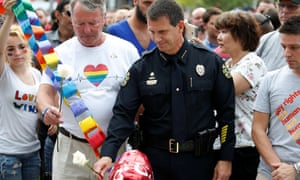
Orlando mayor Buddy Dyer and police chief John Mina at a memorial service for victims
Pinterest
 Orlando mayor Buddy Dyer and police chief John Mina at a memorial service for victims. Photograph: Carlo Allegri/Reuters

Terry DeCarlo of the GLBT Community Center in Orlando told the vigil that he had received messages of condolence and solidarity from all around the world. The mayors of Berlin and London, leaders from Australia, Spain and Brazil had all contacted him “saying Orlando we see you, we stand with you, we love with you,” he said.
Among the huge assembly at the vigil, many of whom carried rainbow flags or the national emblem of Puerto Rico in reflection of the large number of Hispanic victims, was a man who described to the Guardian his extraordinary story of survival at the Pulse. Orlando – he would not give his last name – described how for three terrible hours he lay motionless on the ground in a back bathroom of the club, his head rammed up against the toilet bowl, trying to maintain total silence.
In all that time, he said, as the shooter of the Pulse nightclub massacre calmly moved around him, he kept having just one thought.
“I’m not going to make it out of here. I kept thinking I wasn’t coming out of this, I just wasn’t.”
Orlando and two other terrified club goers at the popular gay venue avoided drawing the gunman’s attention by playing dead, as all around them they could hear the carnage. “Everyone was screaming and bellowing, except for us. Me and my friend kept quiet, we could hear the shooter talking to people in the next bathroom stall.”
The club goer said he heard Mateen ordering people in the adjacent bathroom stall not to use their phones to make text messages. “He said, ‘Please don’t text’. That was the words he used.”
He also heard the shooter make a call, apparently to the police, and making the statement that America should stop bombing Isis in Syria.
Orlando recalls hearing the gunman make reference to a bomb vest in other phone calls, as well as a strange moment in which he demanded to know if anyone in the bathroom was African American. “I have no problems with black people,” the shooter said.

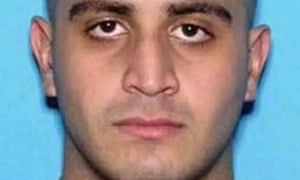
Omar Mateen
Pinterest
 Omar Mateen was a regular at the Pulse nightclub. Photograph: Rex/Shutterstock

Finally, explosions ripped through the wall of the bathroom as the police SWAT team made their controlled entry. The air filled with dust as a hole was punched in the wall, a wild burst of shooting ensued, and Orlando found himself being tugged up out of the stall by officers and hurled physically out of the hole and into the open air.
“An office just grabbed me and flung me out through the hole,” he said.
As he recounted the story, Orlando was still sporting the medical tag from Florida Hospital where he was treated.
Further accounts of the shooter’s apparent interaction with gay culture in advance of his rampage were given by users of a gay dating app Jack’d who told news outlets that Mateen had contacted them through it. Kevin West, 37, a former Navy serviceman, said he been messaged by Mateen on the app.
Though out of touch with him for a few months, West said he had received a message from Mateen saying he was in town and asking to meet for a drink.
West told the LA Times he had immediately contacted the FBI after seeing Mateen’s picture on the news, handing over his login details to his Jack’d app.
Another man apparently messaged by Mateen on the dating app was 23-year-old Cord Cedeno, who also told the Washington Post he had seen Mateen at the club before. “It was definitely him. He’d come in for years, and people knew him,” Cedeno said. “He was open with his picture on the sites; he was easy to recognise.”
His former classmate Samuel King, who also worked at the same shopping mall as Mateen after high school, said Mateen had known that he and many of his friends were gay but never expressed any disapproval. “He had to know it, but I never got any sense of homophobia or aggression from him,” he told the Washington Post.
The information adds to a complex and often contradictory picture that is emerging of the gunman and his motivation for the outrage. His father, Seddique Mateen, hours after the shooting said that Mateen had once become incensed when he saw two men kissing in Miami in front of his wife and child.

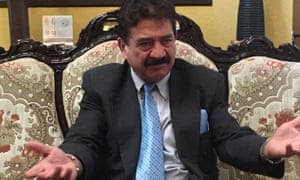
Seddique Mateen speaks with reporters at his home in Port Saint Lucie
Pinterest
 Seddique Mateen speaks with reporters at his home in Port Saint Lucie. Photograph: Reuters

However, in an interview with the Guardian, the father indicated he believed the importance of the incident had been overblown. “But that was a couple of months ago and he never talked about it afterwards,” he said. “I don’t think that incident would trigger this kind of violent reaction.”
Details have also emerged as to how Mateen was able to buy two powerful weapons with which he carried out the attack - .223 assault rifle made by Sig Sauer and a Glock 9mm handgun. He bought the firearms in three separate visits earlier this month to a gun range and store about 15 miles from his home in Fort Pierce.
The owner of the St Lucie Shooting Center, a retired New York city police officer called Ed Henson, told reporters that he had no responsibility for what had happened. Mateen had passed a full federal background check before he was allowed to buy the guns, Henson said, and besides “”If he hadn’t purchased them from us I’m sure he would’ve gotten them from another shop in the area.”
Now that all 49 of the dead have been identified, and their families told the dreadful news, Orlando will be able to begin the long process of grieving. Five of the 53 injured remain in grave condition in hospital, with 47 still in treatment.
President Obama will visit the city on Thursday for a ritual of mourning and reflection that has become all too familiar to him in his eight years in office – this being the 15th time he has had to address the dark subject of mass shootings. Then after that, the funerals will begin.
Pilkington, Ed, and Jessica Elgot. "Orlando Shooter Omar Mateen 'was a Regular at Pulse Nightclub'" The Guardian. Guardian News and Media, 14 June 2016. Web. 14 June 2016.
Response
Gender Identity problem has been the most sensitive issue these days. Orlando shooter Omar Mateen shot and killed 49 people and harmed 53 people at the gay nightclub. Media kept portraying him as a homophobic. However, this article mentions that he used gay dating app and he has shown no homophobic or aggressive actions to gay people. It is unclear why he wanted to kill the people at a gay nightclub but it doesn't clearly seem to be that his hatred of gay people was the only reason to pull the trigger to his insanity. No matter the reason, this action wasn't acceptable and we should all be in grief of those who died. 

Tuesday, 7 June 2016

Amnesty says Malawi albino killings reflect police failures

 LILONGWE, June 7 (Reuters) - Amnesty International accused Malawian police on Tuesday of failing to protect people with albinism who are targeted for their body parts which are used in magical potions and other ritual practices.
Police said they were doing all in their power to end the surge in the killing of albinos in the southern African country. Albinos have also been targeted in Malawi's neighbour Tanzania and elsewhere in Africa.
Deprose Muchena, Amnesty International's Director for Southern Africa, said in a statement that Malawian authorities had failed to protect the albinos, leaving them at the mercy of criminal gangs who hunt them down for their body parts.
The report says at least 18 people with albinism have been killed in Malawi since November of 2014 while at least five others are known to have been abducted and remain missing. Four were murdered in April 2016, including a baby.
"Their bones are believed to be sold to practitioners of traditional medicine in Malawi and Mozambique for use in charms and magical potions in the belief that they bring wealth and good luck," Amnesty said.
"The macabre trade is also fuelled by a belief that bones of people with albinism contain gold."
Malawi government spokesperson and Minister of Information Patricia Kaliati dismissed the claims by Amnesty.
"We are doing everything within the law to stop this carnage," Kaliati told Reuters.
Malawi Police spokesman Nikolasi Gondwa said gangs in neighbouring Tanzania and Mozambique were fuelling the trade.
Albinism is a congenital disorder affecting about one in 20,000 people worldwide who lack pigment in their skin, hair and eyes. It is more common in sub-Saharan Africa. (Reporting by Mabvuto Banda; Editing by Ed Stoddard and James Macharia)

"Amnesty Says Malawi Albino Killings Reflect Police Failures." Mail Online. Ed. Ed Stoddard and James Macharia. Associated Newspapers, 07 June 2016. Web. 07 June 2016.

Response

Albino killings had been a problem in the continent of Africa for a long time. It has become a problem again in Malawi and the problem has even addressed the police problem in Malawi. People are saying that Malawi police has failed to protect albinos in their country and still lots of people are being abducted and killed. This is a religion related problem where African people believe that albinos are somehow magical and they use it in charms and magical potions. It is a barbaric action and it must be stopped no matter what. It clearly violates all the rights of albinos and Malawi government shouldn't take this issue lightly. They must take a clear and definite action to punish those who practice such nonsense, barbaric action against albinos.